Are older women better at living in the present?
Suzanne: “Right now, I am here. My toe swinging in a hammock at Laguna de Apoyo.”
Last month, Suzanne, an island friend of mine sent me a message from Nicaragua. She wrote, I have been thinking about the term “my happy place.” Does a place become your happy place because you are wholly present when you are there? I find it hard to live in the present. I get the impression you are good at it. She then asked how she could better stay in the present for more than two minutes before mentally wandering off to think about other balls in the air.
I have spent some time reflecting on whether I am good at being in the present. You wouldn’t think so from my attempts at meditation! I have also spent years caught in the past and worrying about the future. Would someone actually want to one day marry me? We are celebrating 40 years of marriage in a few months. How would we care for my mother when her money ran out? She died before we had to face that decision. I spent years concerned about not having enough money for retirement. We are far from rich now that we are retired, but with careful planning and smart decisions, we will be fine. My list of worries was long. Most never came to pass. When something did rock the boat, at times even tipping it over, it turned out I was fine - calm, resourceful, and strong.
Older women are better at living in the present
These days, I may not always be wholly present, but I do value the present more. I don’t think this is just due to my age, but rather that my life experiences have taught me the importance of living in the present moment. I think this is true of many older women — and, interestingly, research agrees.
Time feels more precious
As we grow older, we become more aware that time is limited, and we tend to focus on what matters right now rather than worrying so much about the future.
Greater emotional well-being and emotional regulation
These are also changes that come with age. We find it easier to let go of minor frustrations, and avoid unnecessary conflict. We focus more on present-oriented goals.
Less future-oriented pressures
When we were younger, we focused on setting our children on the right path, building our careers, and planning for financial security. Many of the pressures that once pulled us into the future begin to ease in our later years.
Life experience teaches perspective
Most of us have, at some point, lived through loss, failure, and change. We have learned that so much is out of our control, and our worries were needless. How much wiser it is to focus on what is happening now. In the video A Grateful Day, Brother David Steindl-Rast says, “You think this is just another day in your life. It’s not just another day. It is the one day that is given to you. Today. It’s given to you, it's a gift. It's the only gift that you have right now.”
Before I go any further, I want to acknowledge that for some of you, living in the present is not easy - or may not even feel possible. Chronic pain, illness, loneliness, anxiety, or financial worries can all pull attention away from the present.
Five practices to help live in the moment
And, while living in the moment is partly an age-related trait, it is also a skill that needs to be practised. There are research-backed, practical ways to be more in the moment, but I thought I would share some practices that work for me.
1. Not every thought needs to be pondered or solved
Those who know me well know that for too many years, I lived in my head, not in my heart. I had to analyze everything, and I spent many hours thinking, worrying and looking for solutions. These days, I can shut out most thoughts by actually envisioning myself closing the door when a thought lingers, or storing it away in a drawer. If it’s a thought I can’t get rid of, I turn to wonder. I wonder why this thought won’t release its hold on me? What is my reaction telling me?
2. Let go of worries with four simple questions
Are you familiar with Byron Katie’s work, the Four Questions? I have a copy of one of her books that applies her philosophy to the story of Chicken Little, who thinks that the sky is falling when something hits her head. Katie’s questions provide answers and relief.
Is it true?
Can you absolutely know that it's true?
How do you react, what happens, when you believe that thought?
Who would you be without the thought?
When I turn to these questions, my thoughts tend to loosen their grip, and I find myself back in the present more easily.
3. Savouring the moment
This is another gem from Brother David Steindl-Rast - “People ask, can you be grateful for everything? No, not everything, but in every moment.” I used to keep a gratitude journal, writing down three things I was grateful for at the end of every day. Now, I stop myself at random moments during the day to pause and notice. Right this moment, I see the sunshine on a plant hanging down the side of my bookcase. I hear the call of an eagle passing over the house. And then absolute silence - no cars passing by, no appliances humming, just absolute silence. I feel so content in this moment. Stopping like this helps increase my present moment awareness.
4. Single-tasking brings focus
I used to thrive on multi-tasking, jumping from project to project when I worked, or juggling household duties - stopping to water the plants on my way to put the laundry in the dryer. Now I single-task. Don’t you just love that phrase? I focus on one task only and turn off any background distractions - screens, phone notifications, and sometimes even music.
5. Do one thing with full sensory detail
This is a new practice I am incorporating into my repertoire. Pick one daily activity (coffee, shower, walking) and notice three sensory details (smells, textures, sounds, temperature). Sensory attention anchors us in the present.
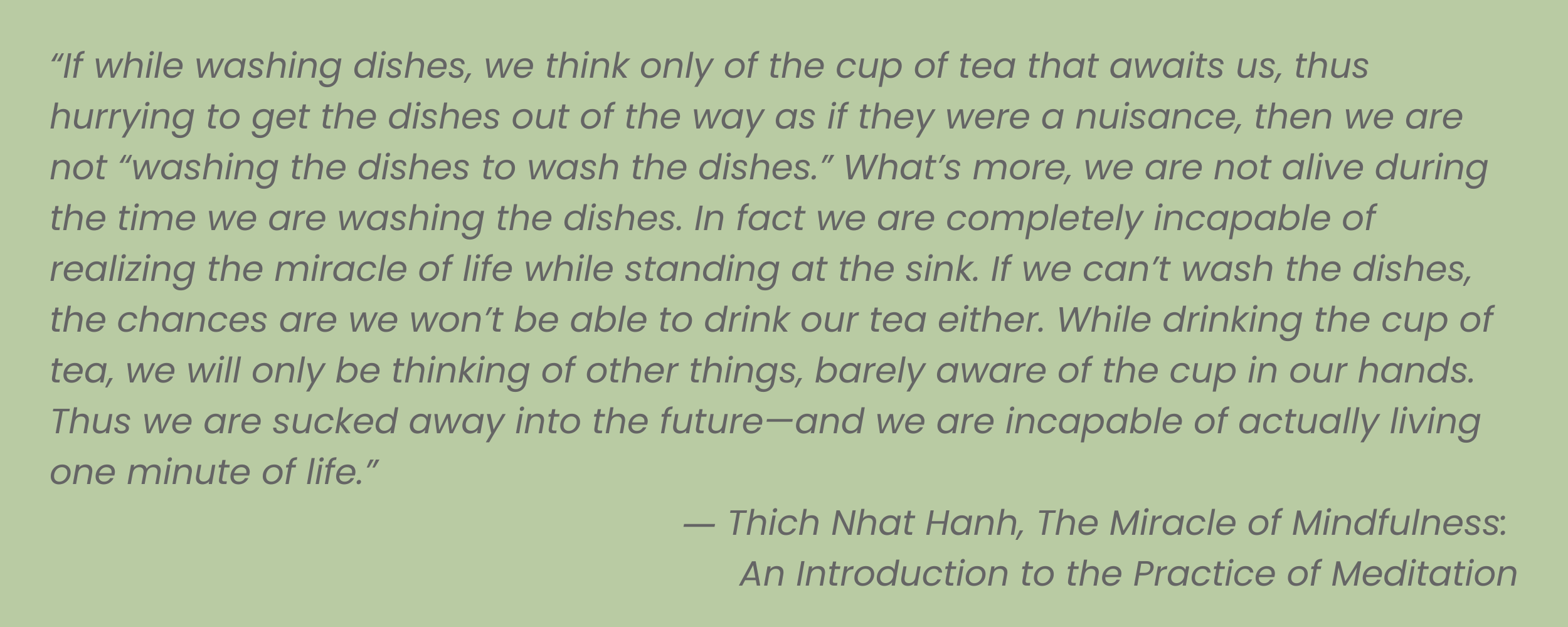
I sent this blog post to Suzanne to ensure I correctly depicted her comments. She sent me a follow up, sharing that she has a friend who has a tattoo that says, now wash the dishes. This represents a core principle of mindfulness famously taught by Zen Master Thich Nhat Hanh.
Do you find yourself better able to live in the present as you age - or is it something you’re still working toward? Do you have any practices to help you live in the moment? Would you consider sharing your experiences with Ageless Possibilities subscribers in the comments below? We’d love to hear from you!